About Me

My photo
Lake Mathews (Perris), CA, United States
Born in Illinois, I grew up in Wilmette, a northern suburb of Chicago. I have one sibling, an older brother. I am married, for the 2nd time now, to Butch & got 4 children in the deal. They have gone on to make me grandmother 25 times over & great-grandmother to over 20!. After many years working in industry, I got my bachelors and masters degrees in speech communication, & was a professor in that field for 13 years. I retired in 2001 & returned to school & got my doctorate in folklore. Now I meld my two interests - folklore & genealogy - & add my teaching background, resulting in my current profession: speaker/author/entertainer of genealogically-related topics. I play many folk instruments, but my preference is guitar, which I have been playing since 1963. I write the "Aunty Jeff" column for the Informer, newsletter of the Jefferson County NY Gen. Soc. I work in partnership with Gena Philibert-Ortega & Sara Cochran as Genealogy Journeys® where we focus on educating folks about Social History. More about that: genaandjean.blogspot.com. More on our podcasts: genjourneys.podbean.com. More about my own projects: Circlemending.org.
Showing posts with label Trapschuh. Show all posts

Sunday, May 3, 2020

Sunday Singalong with Circlemending


It’s been awhile since I’ve engaged others in my blog and song selections. I have been thinking of some great songs that go along with the current state of affairs. Now, most people I know have been quarantined with other family members and so have at least one other person with whom to play games, have meals, take a walk, sing songs, etc. Lots of my friends are making masks for various organizations, others are volunteering in a number of ways that allow for social distancing. Of course, in this home you would expect us to be playing music, writing songs (been enjoying a lot of parodies I’ve heard on Facebook), learning a new instrument . . . you know, those types of activities. Since my husband has been ill, he is really not up to playing the saw or singing and, instead, we have both been watching a lot of TV (not necessarily together).

But last night I enjoyed a gathering of a few of us from the Riverside Folk Song Society where we attempted to do some group singing on Zoom. We weren’t terribly effective, but we still had fun and are going to give it another go later this month. Usually our meetings have a theme, but such was not the case this time around. It was especially nice because a couple of our members, who no longer live in the area, were able to join us for the first time in years! The host of the group, Bob Palmer, was able to put up some lyrics and chords so we could try for a group sing . . . that system needs a few tweaks before it will work for us, but I see it as a fun way to learn new songs, among other things. There are a lot of groups like ours – people who enjoy certain types of music or instruments and are connecting with others, thus making sequestering a learning experience (and part of the learning includes the operation of the required technology).

My German Hollanders and Trapschuhs gather around the piano for a singalong Sunday
Milwaukee, Wisconsin


In the past, I put up a weekly blog called “Sunday Singalong.” Now, I’m not promising a weekly theme, but I hope to get back into this and, at least for the next few weeks – maybe longer – there is plenty of time to seek out a song you remember from childhood, one that you enjoy singing with friends or by yourself, or a favorite piece by a favored artist whose YouTube® performance can be shared here with others. So put on your thinking caps and for this Singalong Sunday (add the song any day this week), our theme is (aptly), SOLITUDE. The song need not contain that word, but should convey that feeling, though it may be a personal connotation – and do share the song meaning or history in your life, if you’ve a mind to. Ideally, include lyrics or a video or audio recording so others can enjoy it too.

SOLITUDE: The first to come to my mind is “I Love to Go A-Wandering” or "The Happy Wanderer" – I remember singing it at camp (don’t ask what year or which one, but I think we sang it in Brownies, too). Now, I, personally, am not prone to go a-wandering (where I live, snakes give me pause and my wandering, these days, tends to be around my own yard, and close to the house, but with eyes still on the ground and never with ear buds to listen to music – can’t hear that distinctive rattle that way). 

Maybe one reason it sticks with me is that it has a German origin, as do I (https://en.wikipedia.org/wiki/The_Happy_Wanderer). The picture (and I’ve found this song in various music books, with exactly the picture I first conjured up when the piece was taught to me) of a lone person walking with a walking stick (no doubt to help keep the snakes away) heading uphill, wearing a backpack (of course), with mountains and trees in the background. I’m not a big fan of backpacks, unless they have wheels, the required equipment for almost every container I transport  . . . but “. . . along the mountain track, . . . my wheely cart by my side . . . “ not only doesn’t rhyme, but removes that picture from the song. But, I confess, in my mind’s eye I don’t picture that hiker as an almost 69-year-old woman! Now, that is an image!
(public domain; stock photo)


Here are some YouTube videos of the song (which, while speaking of solitude, seems to be sung by groups! Go figure).
https://www.youtube.com/watch?v=SVcJIMhmGys (some of the people in this one are wandering on bicycles - not following the song concept at all!)
https://www.youtube.com/watch?v=j_QJi7wVENE (in German, as my ancestors would have sung it?)
https://www.youtube.com/watch?v=BuT3MvLJtLI (some great instrumental accompaniment)
https://www.youtube.com/watch?v=0qJRlUy2Axw (Finally! Primarily a solo - with a full band and echo chorus keeping him company)


What’s your song of SOLITUDE?

Monday, September 11, 2017

My Guardian Angel Worked Overtime: Emptying an Old House is No Picnic - by Virginia Johnson Wilcox

As promised, I am posting here the transcription of my mother's unpublished story about clearing out the old family home in Milwaukee. Some names have been changed (by her). This was originally written as a "homework" assignment for the Off Campus Writer's Workshop (est. 1946) in Winnetka, Illinois and was reviewed by author Len Hilts.
We were eating dinner the night of Saturday, January 9, 1960 when the long dreaded phone call came.

"Aunt May is acting strangely," my mother said. "She sings, laughs, and piles blankets on herself. I think it's mental."

"Have you call the doctor?" I asked.

"You know she doesn't like doctors."

"I'll be there tomorrow morning."

As I packed my bag for the trip to Milwaukee, I wondered how I'd proceed. I had worried about such a situation long before mother and my maiden aunt reached their 80s. Now I had to travel the unknown road alone – without a map. And there was no room for sentiment.

So the next morning I bade goodbye to my husband and two children. "It's just possible I may be bringing Grandma home with me," I said, as I boarded the early train.

When I arrived at the old family home, Aunt May grabbed me and hung on like a frightened child. I didn't want to cause her unhappiness, but I knew there was no choice. I called the doctor.

He arrived a short time later, examined Aunt May, and said to me, "get her to the hospital right away. I'll make arrangements to get her into a nursing home later. And you," he turned to Mother, "go home with your daughter."

I said a little prayer of thanks: my aunt's hospitalization insurance, that I had insisted upon her taking out, had been in effect for one month to the day.

With the help of a relative, we got Mother's and Aunt May's bags packed, Aunt May to the hospital, and Mother and me to the railroad station for our trip home, in a Chicago suburb.

Mother quickly adapted to her new surroundings and was made welcome by family and friends. She was very happy. Now I could to get going on the nitty-gritty.

Word from the doctor indicated that Aunt May would have to spend the rest of her life in a nursing home. Therefore I would, of course, have to sell the Milwaukee house and almost everything in it. But I had no authority to sell anything. The house and most of its furnishings belonged to Aunt May.

First item on the agenda: get  guardianship of Aunt May. This I did through the help of my attorney-cousin, Bob. "I'll do my best to speed it through," he said.

On my next trip to Milwaukee I consulted a real estate agent mother knew and asked him to handle the sale of the house for me. "Do you want to dream or be a realistic?" He asked after he had looked it over.

"I can't afford to dream," I replied. "I need the money to pay medical and nursing home bills for my aunt."

So he quoted a price – 'way below what I could have got for such a house on the North Shore – and I agreed to it. Since I had no idea how much insurance Aunt May carried on the house I told him to buy enough to cover, and to include theft and vandalism, as the place was going to remain vacant for a while.

There were numerous things I had to do before anything could be sold. Such details as mail and newspaper deliveries, arrangements for snow shoveling, changing of bank accounts, and endless minutia required hours of concerted effort. Some things I could do from home, but most had to be done in Milwaukee.

Then came the contents. I had tried taking Mother up with me to make decisions regarding her personal property, but she became too emotional to be of any help, and I realized I'd have to handle things all alone.

Well, not quite alone, as a friend from Chicago went up with me on two occasions. I don't know what I would have done without Dotty. She helped me take things down from the attic, cleaned the silverware, washed dishes, prepared things for sale. Much that I would have thrown away she eagerly took for a resale shop she was interested in.

For her endless work that relieved me of so much I thank both her and my Guardian Angel.

There wasn't a box, bag, envelope, or any other container that did not require opening and a decision made as to its contents. Money I found in many places, including an old sock in Aunt May's dresser drawer. In the attic was a box of about 400 pennies. (After taking out the Eagles and Indian-heads I sold the rest to an interested neighbor.) What in the world Aunt May was doing with a pistol I'm sure I don't know, but I found it on the top shelf of her closet. (Bob took that off my hands; he said it was frozen beyond repair.) Her diamond ring was in a little envelope in a dresser drawer.

And old clothes! The attic was full of them. I hated to throw them out, but I didn't know what else to do. Then I remembered: before I was married I had been involved in dramatic activities and got to know the local costumer quite well. I called him, and he came over and looked at everything I had to offer. In the attic he discovered other items he could use. He was delighted and paid me well for everything he took.

My Guardian Angel was still at work.

The Yellow Pages of the phone directory revealed several used book dealers. I called them and found one who was interested in Civil War books. He came over and brought several; my grandfather had been a Union Army volunteer. Others came and took a few books here, a few there. Then one man bought all the rest for a ridiculously low sum. But I had to get rid of them.

I almost wept when the little girl from next-door came in and bought my grandmother's marvelous old treadle Singer sewing machine, in many ways far superior to new machines of the day. And she paid only five dollars for it.

I am eternally grateful to the many friends who entertained me at dinner and helped me in various ways. "Why don't you get to Mr. Dobson, the antique dealer, to take over for you?" One of them asked me. "He sells households of furnishings all the time."

So I called him. After he had looked through the entire house he said he wasn't interested. But Gertrude, his assistant, upon learning of his refusal, came over the next day and went through the house including the full – and I do mean FULL – attic and basement. She shook her head sadly and said, "You need help. And I'm going to help you."

I thanked my Guardian Angel again.

Perhaps she and I could put on a house sale, Gertrude suggested. I dreaded the prospect of that, but agreed to it. I felt I had a no alternative. It turned out in the end that she found a man, Mr. Edwards, who was willing to manage the whole affair for me.

He came and looked over what I had to offer. He bought a number of items on the spot. Then he said, "There are two ways of handling this. Either I'll take one third of what we get, and you clean up the house, or we split it down in the middle, and I'll take care of everything." Needless to say, I chose the latter arrangement. "But first," he added, "you take whatever you want for yourself and sell things as you can. You will be able to get more for them than I can. Then let me know when you're ready and I'll take over."

This time I really thanked my Guardian Angel.

Weeks turned to months, and I was still making biweekly trips to Milwaukee. And the snow fell whenever it had a mind to. On one occasion it was coming down so thick and fast that, even though I shoveled off the porch at seven in the morning, two hours later, when I wanted to leave for home, I had to do it all over again. To protect myself from the weather I decided to forgo normal dress for the trip, found an old pair of Dad's trousers, put them on over my dress, and, looking like a tramp, walked a block to the bus line. I saw some buses moving, but not in my direction; they never seemed to come back. I spotted a cab and, with several other people, hailed it. We were well packed in by the time we got downtown. I went farther than any of the others, but I'm sure we all paid the same fair. (That driver must have made a bundle that day.)

In spite of the drawbacks of the weather, I swear my guardian angel was looking out for me.

The time came and when I was satisfied that I had taken care of everything I could; I left of the rest in the hands of Mr. Edwards. Finally, on May 12, along with my attorney cousin, I went to the closing of the sale of the property. It had been four months since that nightmare began.

My guardian angel could do now rest for a while.

(This is how the Milwaukee Journal recorded the final sale information - many irreplaceable family relics left the hands of the generations of Johnsons, Hollanders, and Trapschuhs; but as the story related by my mother indicates: the hard decisions had to be made.)

Tuesday, December 21, 2010

Tombstone Tuesday - 21 December 2010 - Helen Lorentzen Clayton

Helen LORENTZEN CLAYTON, the sister-in-law of my great-granduncle, Heinrich (Henry) Ignatz TRAPSCHUH, born 15 July 1864 (probably in Canada) and died 22 December 1892 (108 years ago tomorrow) in Wisconsin, buried in Forest Home Cemetery, Milwaukee, Milwaukee, Wisconsin.

Hoping that posting this may connect me to my relations from that branch of the family. Henry and his wife, Margaretha (May) LORENTZEN TRAPSCHUH, divorced after having 2 children. Henry moved to Minnesota and remarried. Margaretha stayed in Milwaukee. I know nothing of their relationship.

Tuesday, December 7, 2010

Tombstone Tuesday - 7 December 2010 - Cleveland H. Sherman

Cleveland H. SHERMAN, born: 11 July 1884, died: December 1974
Buried: Spokane, Spokane, Washington

He was married to my 1st cousin, twice removed (Florence Luella TRAPSCHUH, daughter of my great-granduncle).

Thursday, July 15, 2010

Treasure Chest Thursday - 15 July 2010 - Carrom


The TRAPSCHUH family of Milwaukee (one son, Gustav, left to make his life in Ohio, then relocated to Spokane, Washington, where some of that part of the family still live) were great game players. They enjoyed such games as Carrom - shown here is their original set which I have stewardship over; it is really many games in one (and the board has 2 sides for more versatility - it hangs on my wall and pulling it down to photograph the opposite side was a bit cumbersome, so only one side is shown here, however, to see the other side, check the board one can still purchase - in a newer version - from Toys R Us). The history behind the game is described on Wikipedia.

Ah, the pre-video-game days did not mean boring evenings . . . and people probably talked to each other more while they played!

Wednesday, July 14, 2010

Wordless Wednesday - 14 July 2010 - Trapschuh family, Spokane, Washington

Florence Luella TRAPSCHUH (who was the subject of yesterday's Tombstone Tuesday)


Florence Luella TRAPSCHUH was the youngest of Gustav Mathias TRAPSCHUH's offspring - she is at the far right here with her siblings (two older ones had died as children).


Home of Carl Grover TRAPSCHUH, Spokane, Spokane, Washington (sister, Florence TRAPSCHUH SHERMAN, is at far left)

Photos, courtesy of Melody Murphy . . . to whom I owe a debt of gratitude for caring for the photos of our ancestors.

Tuesday, July 13, 2010

Tombstone Tuesday - 13 July 2010 - Florence Luella Trapschuh Sherman

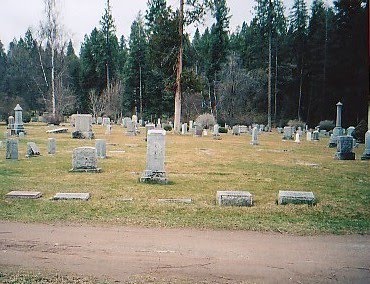
TRAPSCHUH plot in Greenwood Cemetery, Spokane, Spokane, Washington

Florence Luella TRAPSCHUH SHERMAN, b: 10 August 1887, Ohio, USA; d: July 1972, Spokane, Spokane, Washington, USA.

Florence married Cleveland H. SHERMAN in about 1904 in Spokane and they had 7 children, 5 of which lived past childhood.

Florence was my first cousin, twice removed. I was reconnected with that part of the family a few years ago, thanks to the Internet. The above photo was taken by Lance MURPHY, my third cousin. I appreciate his help and that of his mother, Genevieve TRAPSCHUH JOHNSTON, who helped fill in a lot of blanks for this side of my family.

Thursday, May 27, 2010

Treasure Chest Thursday: Before there were video games

Ignatz Trapschuh (see blogs of last 2 days) was a cabinet-maker. He was an artisan and his skill was amazing; he was able to provide for his large family by making furniture and selling it to his fellow Milwaukee residents. But, when work was scarce, he and his wife, Maria Theresa Knoetgen, went from door to door, carrying a glue pot and repairing the furniture of their neighbors for the small cost of 5 or 10 cents. Another side-line job was to take horsehair mattresses, remove the hair from the ticking, and wash and air it; then Maria would restuff and sew up the mattresses; a nasty job, but necessary and one which helped the family make ends meet.

Some of Ignatz's handiwork (a dresser and a bedstead) had been part of my family's household until the 1960s when things were sold. Ignatz, my g-g-grandfather, made a "Skittles" (AKA, in our house, "Devil among the Tailors") game with a huge playing box. The original box is gone now (it was very heavy and impossible to keep; the bottom got warped and it could no longer be used for the game, so we have replaced it with a lighter playing box). But the pieces Ignatz carved are still part of my treasures. A few years before it was given to me, my mother had tried to sell the entire set (I learned this just recently when reading about it in her diaries - no one wanted to buy it, so it was relegated back to our attic and then, in the 1970s, offered to me). I cherish these pieces, knowing that my great-great-grandfather made them by hand. I also imagine that the family played with the game during their many gatherings for fun and music. Of course the string on the top has been replaced (a number of times); the set hangs on our wall, but we have taken it down and let the grandchildren play with it over the years . . . carrying on a tradition.

(To see what this game, the precursor to the pinball machine, looks like, check Masters Traditional Games where it is called Toptafel. To learn about the English history of this game, check this site on Traditional games.)

Wednesday, May 26, 2010

Wordless Wednesday - 26 May 2010

Ignatz Trapschuh (see yesterday's "Tombstone Tuesday")
Maria Theresa Knoetgen & husband Ignatz Trapschuh (ca. 1861)

Tuesday, May 25, 2010

Tombstone Tuesday - 25 May 2010 - Ignatz Trapschuh

The Trapschuh marker, Forest Home Cemetery

The family headstone


Ignatz Trapschuh, cabinet-maker; husband of Maria Theresa Knoetgen (md: August 1838, Austria)
b: 20 August 1815, Hochpetsch, Bohemia, Austria
d: 26 May 1893, Milwaukee, Milwaukee, Wisconsin (117 years ago tomorrow)
buried: Forest Home Cemetery, Milwaukee, Milwaukee, Wisconsin


Lot 2, Block 67, Section 23

Saturday, May 8, 2010

Saturday Night Genealogy Fun - Mom's mom's mom's mom


In honor of mother's day, I am responding to Randy Seaver's challenge to identify my matrilineal line. This is fairly easy for me as these special people dwell in my heart and their identities are noted in my mind (but I do have to check the pedigree to get the exact dates for all the events).


My mother was Virginia Marie Johnson Wilcox, b: 24 August 1911, Milwaukee, Milwaukee, Wisconsin; d: 24 June 1994, Evanston, Cook, Illinois

A significant time in her life: She essentially single-handedly cleaned out 4 homes of relatives when they either died or were no longer able to live in their houses; she handled every detail and kept meticulous records of all the items and experiences, aided by the fact that she kept a daily diary for most of her adult life (the last entry was 4 days before her unexpected death and 1 day before she slipped into a coma).

Her mother was


Emma Marie Hollander Johnson, b: 9 August 1873, Milwaukee, Milwaukee, Wisconsin; d: 10 September 1964, Glenview, Cook, Illinois

A significant time in her life: When her father lost his sight, Emma maintained the records of the family home and the business, orchestrating the necessary tasks to supervise the building of a new house, shortly after losing her fiance to death.

Her mother was


Caroline (Carrie) Maria Trapschuh Hollander, b: 16 December 1844, Belin, Bohemia, Austria; d: Milwaukee, Milwaukee, Wisconsin

A significant time in her life: After meeting her future husband, saying "goodbye" to him as he went off to serve in the Civil War. He returned to her and they made a life together, but she ended up nursing him after he went blind in later life.

Her mother was


Maria (Mary) Theresa Knoetgen Trapschuh, b: 23 February 1816, Bohemia, Austria; d: 18 April 1899, Milwaukee, Milwaukee, Wisconsin

A significant time in her life: Leaving Bohemia and her family in Teplitz to make a life in America with her husband, a cabinet maker, and children; the voyage lasted nearly 3 months and the passengers on the small whaling brig had to resort to eating potato peelings to stay alive. Though she watched the burial at sea of many fellow passengers, Mary lost none of her 5 children that also made the trip (3 more were born in America).

The mitochondrial DNA has clarified that my roots lie in the Czech Republic (no surprise there). What the DNA does not show: the strength that these women possessed and, hopefully, passed on to me.

Tuesday, April 20, 2010

Tombstone Tuesday - 20 April 2010 - Knoetgen/Trapschuh

Maria Theresa Knoetgen Trapschuh, wife of Ignatz Trapschuh, b: 23 February 1816, Bohemia; d: 18 April 1899 (101 years ago this week), Milwaukee, Milwaukee, Wisconsin; buried 20 April 1899 (101 years ago today), Forest Home Cemetery, Milwaukee, Wisconsin. She was the daughter of Baron Johann Knoetgen of Teplitz, Bohemia.

Thursday, February 18, 2010

Treasure Chest Thursday - 18 February 2010

The banjo I am playing (at the San Diego Genealogical Society January seminar this year) belonged to my great-grandmother, Caroline Trapschuh Hollander (though I suspect it was really her son, my grand-uncle Albert Hollander, who played it). It was reconditioned a couple of years ago, sounds great & looks wonderful! It's the banjo I learned on back in the 1960s, but was relegated to the wall (as a decoration) when pieces of the fingerboard started to crack and come off.

A couple of years ago a friend of mine was over, checked it out, and discovered it to be an 1889 Fairbanks & Cole parlor banjo. He talked me into having it repaired and I sent it to a banjo genius, Vern Marr, in Oregon. He used the original parts of the neck to bring it back to playing capability, replaced the skin, replaced the inlays, put in tuning machines that look vintage but are actually amazingly efficient 21st Century replicas, and strung it with light gauge strings (it originally had gut strings, but an attempt to use nylon - today's replacement for gut - left it sounding dead; the steel strings give it a bright sound).

I treasure this piece of my family's history and only wish I knew more about the people who played it before it fell into my hands (thanks to my mother's insistence on not throwing anything - especially musical instruments - away).


I'll have it with me at the St. George Family History Expo, coming up next week!

Thursday, January 7, 2010

Treasure Chest Thursday - 7 January 2010

As I have said before, my family was never one to use a wastebasket, so I have all sorts of ephemera that the neighbors of my Wisconsin families probably threw out right after the holidays. Not so in the Hollander, Johnson, and Trapschuh homes: they kept the holiday magazines that now I use as part of my Christmas decorations. This year, very few decorations went up due to illnesses in our home, but I did display the books and magazines from holidays past (most, long, long passed). But now, with 12th night behind us, I must pack them away for a season . . . but I'll haul them out next year and the year after that, etc., enjoying the look into lives that, to some, were simpler than ours (I don't necessarily agree: I love my dishwasher, washing machine, computer, automobile, etc.). So here's one last look at a holiday favorite from 110 years (and one month) ago.

Thursday, December 31, 2009

Treasure Chest Thursday - 31 December 2009; letter from Carl Glaser, Bohemia


Happy New Year!

In November, 1899, my 1st cousin, 3x removed, wrote to his cousin, probably Anna Wilhelmina TRAPSCHUH, daughter of my g-g-grandmother Maria Theresa KNOETGEN TRAPSCHUH, to catch her up on the family (who was still alive, who was married to whom, etc.). His last words of the letter, as I'm sure he knew that he would not write again before the turn of the year, was "prosit newyear" (toast the New Year). It was 1899, with 1900 about to arrive . . . 110 years ago. How cool it is that I still have that letter from cousin Charles GLASER of Teplitz, Bohemia to his cousin; even after the death of his aunt he stayed in touch with family and let people know how things were in the old country. (Note: he wrote many letters and most were in German; this is the only one that he wrote in English.)

Charles (Carl) GLASER; b: abt. 1843, Bohemia (no death information is known; his children and other family members no longer kept contact with the American family after his death, sometime after his last letter in 1901)

his cousin and most likely recipient of the letter: Anna Wilhelmine TRAPSCHUH; b: 28 May 1840, Austria; d: 18 Dec 1912, Milwaukee, Milwaukee, Wisconsin (never married)


her mother and Carl's aunt:
Maria Theresa KNOETGEN; b: 23 Feb 1816, Bohemia; d: 18 Apr 1899, Milwaukee, Milwaukee, Wisconsin

Thursday, December 3, 2009

Treasure Chest Thursday - 3 December 2009

The passport for my great-great-grandparents, Ignatz & Maria Theresa (Knoetgen) Trapschuh for their 1849 trip to America on the whaling brig, William and Joseph. This lists the birth place of Ignatz - Hochpetsch, Bohemia.

They sailed on 13 February 1849 and the trip took until the end of March. The food ran out & they had to eat potato peelings. Great-grandmother told of seeing people who had died being thrown overboard, but in this family, everyone survived the trip.


All the children and birth years were listed on the back (my great-grandmother was Caroline). The youngest listed here, Gustav, always said he was born in Milwaukee, Wisconsin, but this proves he was born in Austria (Bilin).


I am very grateful that my family threw nothing away. This is a prized possession!

Thursday, November 5, 2009

Treasure Chest Thursday - Great-grandmother's brooch

Great-grandmother Caroline Maria TRAPSCHUH HOLLANDER. The cameo brooch she is wearing is now in my possession and I wear it when I do a program where I impersonate her. I treasure that piece of jewelry.

Wednesday, November 4, 2009

Wordless Wednesday, 4 November 2009

The Spokane, Washington TRAPSCHUH family. Date unknown. Photo courtesy of Melody Murphy.

Tuesday, November 3, 2009

Tombstone Tuesday, 3 November 2009


Anna Estell TRAPSCHUH was born 3 February 1879 in Ohio. She married(1) Mr. CLARK about 1898 and divorced him. They had two children. She married(2) John HERMAN about 1904 and they had two children. She died 4 November 1956, at age 77 (53 years ago tomorrow), in Spokane, Spokane, Washington, where she is buried in the TRAPSCHUH plot.


Her offspring are Hazel and Helene CLARK and Elaine and Russell HERMAN. They would be my second cousins, once removed and their children (if any of them had any) would be my third cousins. I would love to locate them!